Daily Walkaround Checks for Vans, Trucks and Buses: The Checklist and the Records to Keep
In Ireland the driver of a van, truck or bus must look over the inside and walk around the outside before driving it in a public place, and report any defect to the owner in writing or electronically. The owner must have defects repaired and keep the maintenance and repair records for at least two years, under S.I. No. 348 of 2013.
At a glance
Checked against 6 official sources- The law
- S.I. No. 348 of 2013, the RSA vehicle maintenance and repair regulations
- Vehicles covered
- Every goods vehicle including vans, buses with more than 8 passenger seats, goods trailers over 3,500 kg and ambulances
- When
- Before the vehicle is driven in a public place. A driver needn't repeat it on the same vehicle within 24 hours
- Defects
- Reported to the owner in writing or electronically, with the date and time found
- Records
- Kept for at least 2 years
- Penalty for the owner
- A fine of up to €5,000, up to 6 months in prison, or both
On this page 12 sections
A commercial vehicle's CVRT is a check on one day of the year. The walkaround check is the one that happens on all the others. It takes a driver a few minutes, it is a legal requirement for vans as well as trucks and buses, and it is the first thing an RSA inspector asks about when they visit your yard.
What the law requires
The rules are in S.I. No. 348 of 2013, the Road Safety Authority (Commercial Vehicle Roadworthiness) (Vehicle Maintenance and Repair) Regulations. They apply to:
- Goods vehicles of every size, from a small van to an articulated truck
- Buses and coaches with more than 8 passenger seats
- Goods trailers over 3,500 kg
- Ambulances
Before driving one of these in a public place, the driver must inspect the inside of the vehicle and walk around it to inspect the outside. They don't have to repeat the check on the same vehicle more than once in any 24 hours. The owner, which for a company vehicle means the business, must make sure the check happens and that everyone who may drive the vehicle is trained to do it.
The walkaround checklist
Schedule 1 of the regulations lists the items to look at, as far as each one applies to the vehicle:
| Where | What to check |
|---|---|
| In the cab | Mirrors, windows, driving controls, seat belts, washers and wipers, horn, tachograph, ABS and EBS warning lights, instruments and warning lights, air leaks and pressure |
| Outside | CVRT, tax and insurance discs, tyres, wheel condition and security, all lights and reflectors, exhaust, number plates, steps, body, doors and curtains |
| Fluids and fuel | Engine oil, coolant, washer fluid, fuel level and leaks |
| The load | Load security and weight distribution |
| Trailer and coupling | Coupling, fifth wheel and locking devices, air and electrical connections, landing legs, trailer park brake, air suspension, marker plates |
| Engine running | Steering and brakes |
The RSA's own check sheets add a few items by vehicle type. The bus sheet adds passenger seats, doors and emergency exits, the fire extinguisher, the first-aid kit and the interior. The truck sheet adds the speed limiter, side guards and under-run protection, and spray suppression. The van sheet adds a hi-vis vest in the cab and checking that the van sits level.
How long a check takes
Not long. The RSA's guide to keeping a commercial vehicle roadworthy says a basic check can be done "in just 60 seconds for a small van and a few minutes for a HGV or bus". A truck and trailer checked properly takes longer, but it is still the cheapest safety control a fleet has.
When the driver finds a defect
The driver must tell the owner as soon as reasonably practicable, in writing or electronically, with:
- A detailed description of the defect
- The time and date it was found
- Anything the driver did as a temporary fix
If the driver believes the defect makes the vehicle a danger, they must not drive it, or must stop as soon as it is safe if they are already on the road, until a suitably qualified person has inspected it and, where needed, repaired it. That call belongs to the driver. A culture that leans on drivers to keep going with a fault is one that ends up in breach of the law.
What the owner must do next
The owner must have the defect repaired by a suitably qualified person as soon as reasonably practicable. The regulations define that as someone whose training, qualifications or experience let them judge the vehicle's roadworthiness and repair it properly, which in practice means your mechanic or maintenance provider.
The loop is only closed when you can show the whole chain for any defect: when it was reported and by whom, who assessed it, when it was repaired and by whom, and the invoice.
The records to keep, and for how long
Regulation 10 requires the owner to keep inspection, maintenance and repair records for each vehicle, on paper or electronically, including:
- The registration, model and year of the vehicle
- The start and end dates of any lease or hire-purchase agreement
- Every defect found by, or reported to, the owner or a driver
- Each inspection and service: who did it, when, what they found, and a copy of the invoice
- Each repair: who did it, and the invoices for the work and any parts
- The odometer reading at each inspection, service or repair
- CVRT test reports, pass statements and certificates of roadworthiness
- Any documents an authorised officer or CVR inspector gave you
Keep them for at least two years from when each record is made. Paper records belong at your principal place of business or where the vehicle is normally kept. Electronic records must open straight away from your principal place of business.
The regulations don't spell out that a check with nothing wrong must be written down, but the RSA treats recording every check as good practice and its inspectors ask to see walkaround records. A signed sheet that says "no defects" is the only evidence a check happened at all.
Inspections are a separate duty
The walkaround check doesn't replace the periodic safety inspections the owner must also arrange. Regulation 6 leaves the interval to the owner, who sets it from the vehicle's age, mileage and condition, how it is used, and the manufacturer's and the RSA's guidance. The RSA's indicative chart runs from about every 13 weeks for a lightly loaded vehicle doing low mileage to about every 4 weeks for arduous work at very high mileage. See what HGV and bus operators must record for how those inspections work.
Owners of buses, of goods vehicles and trailers over 3,500 kg, and of ambulances must also make an annual self-declaration to the RSA about their maintenance arrangements. Van owners don't have to.
Who checks that you do it
RSA vehicle inspectors carry out roadside checks with An Garda Síochána, and visit operators' premises, sometimes without notice, to look at the maintenance system, walkaround and repair records, driver training and the self-declaration. An inspection can end with a warning, a direction to put something right, vehicles taken off the road, a follow-up visit or a prosecution. An owner convicted of breaching the maintenance rules faces a class A fine of up to €5,000, up to six months in prison, or both.
The RSA also gives operators a red, amber or green risk rating, worked out from the infringements recorded against them over the previous two years. Operators rated red are more likely to be picked for checks.
Making it stick
- Give every vehicle a check sheet, on paper or in an app, with the items in a fixed order
- Train everyone who drives, including agency and occasional drivers, and record the training
- Make reporting a defect easy, and never treat it as the driver's fault
- Name one person who reads the defect reports every day and decides what happens to each one
- File each repair against the defect it fixed, with the invoice
- Spot-check the sheets. Twenty identical ticks in a row is a sign nobody is looking
Where FleetMain fits
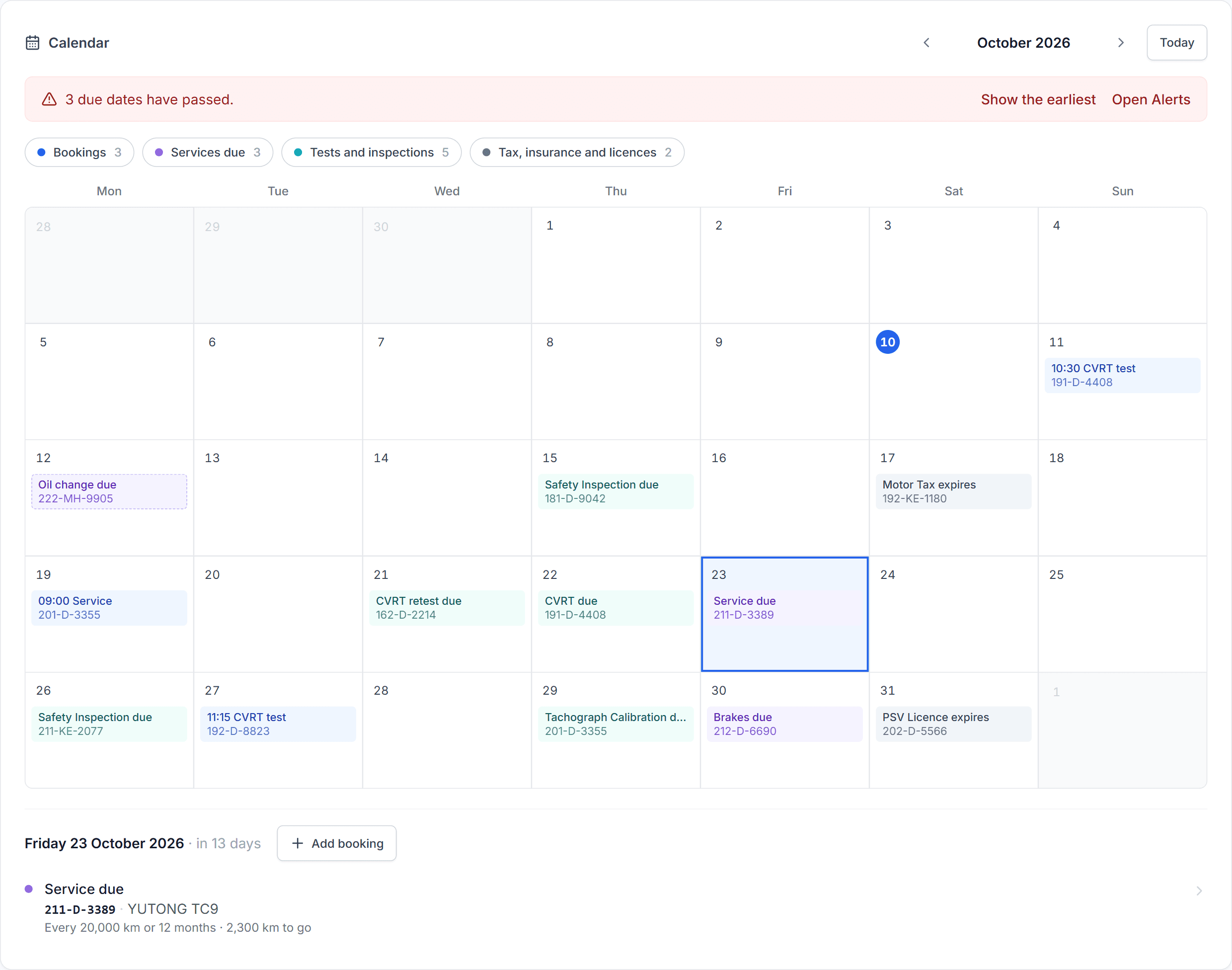
FleetMain doesn't replace the daily check sheet: paper or a walkaround app does that job. What FleetMain keeps is the vehicle history around it:
- Service and repair records for each vehicle with the date, odometer reading, cost and the work done, with the invoice attached as a PDF or a photo
- Due dates for safety inspections on trucks and buses, and on vans if you choose to run them, alongside the CVRT, tachograph calibration, motor tax and insurance
- Email reminders before each date, and a regular reminder of anything already overdue
- On the Business and Fleet Pro plans, a log of which driver had which vehicle and when, so a defect report can be matched to the person who found it
This article is a general summary of the walkaround check and record-keeping rules, not legal advice. Confirm the requirements for your own vehicles with the Road Safety Authority.
Common questions
Do vans need a daily walkaround check in Ireland?
Yes. S.I. No. 348 of 2013 applies to every goods vehicle, including vans, as well as buses with more than 8 passenger seats, goods trailers over 3,500 kg and ambulances. The driver must check the vehicle before driving it in a public place.
How often does a walkaround check have to be done?
Before the vehicle is driven in a public place. A driver doesn't have to check the same vehicle more than once in any 24 hours, so in practice it is a check before the first journey of the day. The exemption belongs to the person, so a driver taking over a vehicle someone else checked that morning should do their own check.
How long do walkaround and defect records have to be kept?
At least two years from when each record is made. That covers defect reports and the inspection, maintenance and repair records for each vehicle. The RSA also recommends keeping the check sheets with nothing wrong on them, since they are the only evidence a check happened.
Who is responsible for walkaround checks, the driver or the company?
Both. The driver must do the check, report defects and refuse to drive a vehicle with a dangerous one. The owner must make sure checks happen, train everyone who drives, have defects repaired and keep the records. An owner convicted of breaching the rules faces a fine of up to €5,000, up to six months in prison, or both.
Can walkaround checks be done on an app instead of paper?
Yes. The regulations let drivers report defects electronically or in writing, and let owners keep records electronically, as long as they can be opened straight away from the business's main place of business in Ireland.
Sources
Every rule in this guide was checked against these pages on 20 October 2026.
- S.I. No. 348 of 2013: Road Safety Authority (Commercial Vehicle Roadworthiness) (Vehicle Maintenance and Repair) Regulations 2013 (irishstatutebook.ie)
- Road Safety Authority (Commercial Vehicle Roadworthiness) Act 2012, section 30 (revisedacts.lawreform.ie)
- CVRT: Daily walk-around checks and defect detection (cvrt.ie)
- CVRT: Record keeping requirements (cvrt.ie)
- CVRT: Preventative maintenance (cvrt.ie)
- RSA: Guide to keeping your commercial vehicle roadworthy (cvrt.ie)
Related guides
- Preventative Maintenance Inspections: What HGV and Bus Operators Must Record
The CVRT is once a year. Your roadworthiness obligation is every single day. Here’s how the periodic safety inspection regime works, what records you’re expected to hold, and how operators keep it manageable.
- CVRT (the DOE Test): When It's Due, What It Costs and How Retests Work
The CVRT, still the DOE test to most people, comes round every year for every van, truck, bus and heavy trailer. Here is which vehicles need it, when it is due, the 2026 fees, how retests work, and the penalty for driving without one.
- Fleet Compliance Checklist for Ireland: Every Date Your Vehicles, Drivers and Business Need
Tax, tests and insurance are only the start. Here is every compliance date an Irish fleet has to keep, for the vehicles, the drivers and the business itself, with how often each one comes round and where it is renewed.