Fleet Compliance Checklist for Ireland: Every Date Your Vehicles, Drivers and Business Need
Every vehicle in an Irish fleet needs motor tax, insurance and a roadworthiness test: the NCT for cars, the CVRT for vans, trucks and buses. Trucks and buses add tachograph calibration and safety inspections. Professional drivers carry their own licence, Driver CPC, tachograph card and ADR dates, and haulage and bus businesses hold an operator licence.
At a glance
Checked against 11 official sources- Every vehicle
- Motor tax, insurance, and the NCT or CVRT
- Trucks and buses
- Tachograph calibration at least every 2 years, and safety inspections at the interval you set
- Buses and taxis
- A vehicle licence: from the Gardaí for buses, the NTA for taxis
- Professional drivers
- Driving licence, Driver CPC card, tachograph card, ADR certificate
- The business
- A road transport operator licence, issued for up to 5 years
- Records
- Maintenance, inspection and defect records kept for at least 2 years
On this page 8 sections
Ask an operator what they have to keep track of and the answer is usually "tax, test and insurance". That is right for a single car. For a fleet with vans, trucks or buses, and drivers who drive for a living, the list is longer, the dates run on different cycles, and several of them sit on the driver or the business rather than the vehicle. Here is the whole list for Ireland in 2026.
Vehicle dates
Motor tax
- How often
- 3, 6 or 12 months
- Applies to
- Every vehicle used in a public place
- Where
- motortax.ie or a motor tax office
Insurance
- How often
- Usually every 12 months
- Applies to
- Every vehicle
- Where
- Your insurer or broker
NCT
- How often
- At 4 years, every 2 years until 10, then yearly. Taxis yearly, then every 6 months from 10 years old
- Applies to
- Cars, including taxis, hackneys and limousines
- Where
- ncts.ie
CVRT
- How often
- Every year from the 1st anniversary of registration
- Applies to
- Vans and all goods vehicles, buses with more than 8 passenger seats, ambulances, trailers over 3,500 kg
- Where
- An authorised test centre, booked at cvrt.ie
Tachograph calibration
- How often
- At least every 2 years, and after repairs or a tyre size change
- Applies to
- Vehicles fitted with a tachograph
- Where
- An NSAI-approved tachograph workshop
Safety inspection
- How often
- At the interval you set: the RSA's guide runs from about 13 weeks down to 4
- Applies to
- Trucks, buses and heavy trailers, and vans if you choose to
- Where
- Your maintenance provider
Service
- How often
- At the manufacturer's distance or time limit, whichever comes first
- Applies to
- Every vehicle
- Where
- Your garage
Bus vehicle licence
- How often
- Usually 3 years
- Applies to
- Buses and coaches carrying passengers for reward
- Where
- An Garda Síochána
Taxi vehicle licence
- How often
- Every year, or every 6 months for some older vehicles
- Applies to
- Taxis, hackneys and limousines
ADR vehicle certificate
- How often
- Every year
- Applies to
- Tankers and other vehicles approved to carry dangerous goods
- Where
- The RSA, after a CVRT pass
| Date | How often | Applies to | Where |
|---|---|---|---|
| Motor tax | 3, 6 or 12 months | Every vehicle used in a public place | motortax.ie or a motor tax office |
| Insurance | Usually every 12 months | Every vehicle | Your insurer or broker |
| NCT | At 4 years, every 2 years until 10, then yearly. Taxis yearly, then every 6 months from 10 years old | Cars, including taxis, hackneys and limousines | ncts.ie |
| CVRT | Every year from the 1st anniversary of registration | Vans and all goods vehicles, buses with more than 8 passenger seats, ambulances, trailers over 3,500 kg | An authorised test centre, booked at cvrt.ie |
| Tachograph calibration | At least every 2 years, and after repairs or a tyre size change | Vehicles fitted with a tachograph | An NSAI-approved tachograph workshop |
| Safety inspection | At the interval you set: the RSA's guide runs from about 13 weeks down to 4 | Trucks, buses and heavy trailers, and vans if you choose to | Your maintenance provider |
| Service | At the manufacturer's distance or time limit, whichever comes first | Every vehicle | Your garage |
| Bus vehicle licence | Usually 3 years | Buses and coaches carrying passengers for reward | An Garda Síochána |
| Taxi vehicle licence | Every year, or every 6 months for some older vehicles | Taxis, hackneys and limousines | National Transport Authority |
| ADR vehicle certificate | Every year | Tankers and other vehicles approved to carry dangerous goods | The RSA, after a CVRT pass |
The cycles that catch people out: vans take the CVRT every year from their first anniversary, not at four years like a car, and taxis take the NCT, not the CVRT. A heavy vehicle's CVRT doesn't replace its safety inspections, and a safety inspection doesn't replace a service. Each has its own date.
More detail: the CVRT, the NCT, motor tax on vans and trucks, safety inspections, service schedules.
Driver dates
Driving licence
- How often
- Car licence (B) usually 10 years. Truck and bus licences (C, D) usually 5 years, with a medical report at each renewal
- Applies to
- Every driver
- Where
- NDLS
Driver CPC card
- How often
- Card valid up to 5 years, with one 7-hour training module every year
- Applies to
- Professional truck and bus drivers
- Where
- The RSA, posted automatically once the training is recorded
Tachograph driver card
- How often
- Every 5 years
- Applies to
- Anyone driving a vehicle with a tachograph
- Where
- The RSA
ADR certificate
- How often
- Every 5 years, with a refresher course in the final year
- Applies to
- Drivers carrying dangerous goods
- Where
- An approved ADR training provider. CILT issues the certificate for most classes
| Date | How often | Applies to | Where |
|---|---|---|---|
| Driving licence | Car licence (B) usually 10 years. Truck and bus licences (C, D) usually 5 years, with a medical report at each renewal | Every driver | NDLS |
| Driver CPC card | Card valid up to 5 years, with one 7-hour training module every year | Professional truck and bus drivers | The RSA, posted automatically once the training is recorded |
| Tachograph driver card | Every 5 years | Anyone driving a vehicle with a tachograph | The RSA |
| ADR certificate | Every 5 years, with a refresher course in the final year | Drivers carrying dangerous goods | An approved ADR training provider. CILT issues the certificate for most classes |
Driver dates follow the person, not the vehicle. A driver moving between vehicles, or an agency driver covering for a week, brings their own dates with them, and a lapsed card stops that driver working whatever the state of the vehicle. More detail: Driver CPC, drivers' hours and tachographs.
Business dates
Road transport operator licence
- How often
- Issued for up to 5 years
- Applies to
- Haulage for hire or reward over 3,500 kg (over 2,500 kg abroad), and bus and coach operators
- Where
- rtol.ie, the Department of Transport's licensing unit
Fleet insurance policy
- How often
- Usually every 12 months
- Applies to
- Fleets insured on one policy
- Where
- Your insurer or broker
RSA annual self-declaration
- How often
- Every year
- Applies to
- Owners of buses, goods vehicles and trailers over 3,500 kg, and ambulances
- Where
- The RSA, through cvrt.ie
| Date | How often | Applies to | Where |
|---|---|---|---|
| Road transport operator licence | Issued for up to 5 years | Haulage for hire or reward over 3,500 kg (over 2,500 kg abroad), and bus and coach operators | rtol.ie, the Department of Transport's licensing unit |
| Fleet insurance policy | Usually every 12 months | Fleets insured on one policy | Your insurer or broker |
| RSA annual self-declaration | Every year | Owners of buses, goods vehicles and trailers over 3,500 kg, and ambulances | The RSA, through cvrt.ie |
A haulier also has to keep its operator licence evidence current through the life of the licence: a transport manager, financial standing, and an operating centre. See the operator licence guide.
The records behind the dates
Dates are what lapse. Records are what an inspector asks to see:
- Maintenance, inspection, repair and defect records for each commercial vehicle, kept for at least two years, with the odometer reading and invoice for each job. See walkaround checks and the records to keep
- Tachograph data: driver cards downloaded at least every 28 days and vehicle units at least every 90 days, kept for at least 12 months
- A record of which driver had which vehicle and when, so a fixed charge notice can be nominated within its 28 days. See how to prove who was driving
How to keep it all in hand
- Put every date for every vehicle and driver on one list, not a list per person
- Give each date an owner: the person who will actually book the test or renew the policy
- Set reminders far enough ahead for the job. A test needs a few weeks to get a slot, an insurance renewal needs time to compare quotes
- Keep being reminded after a date lapses, until it is renewed. Silence after the expiry date is how a lapse turns into a summons
- Update each date the day the renewal comes through
- Review the whole fleet once a month, red and amber first
The cost of missing one is covered in the penalties for untaxed, uninsured and untested vehicles.
Where FleetMain fits
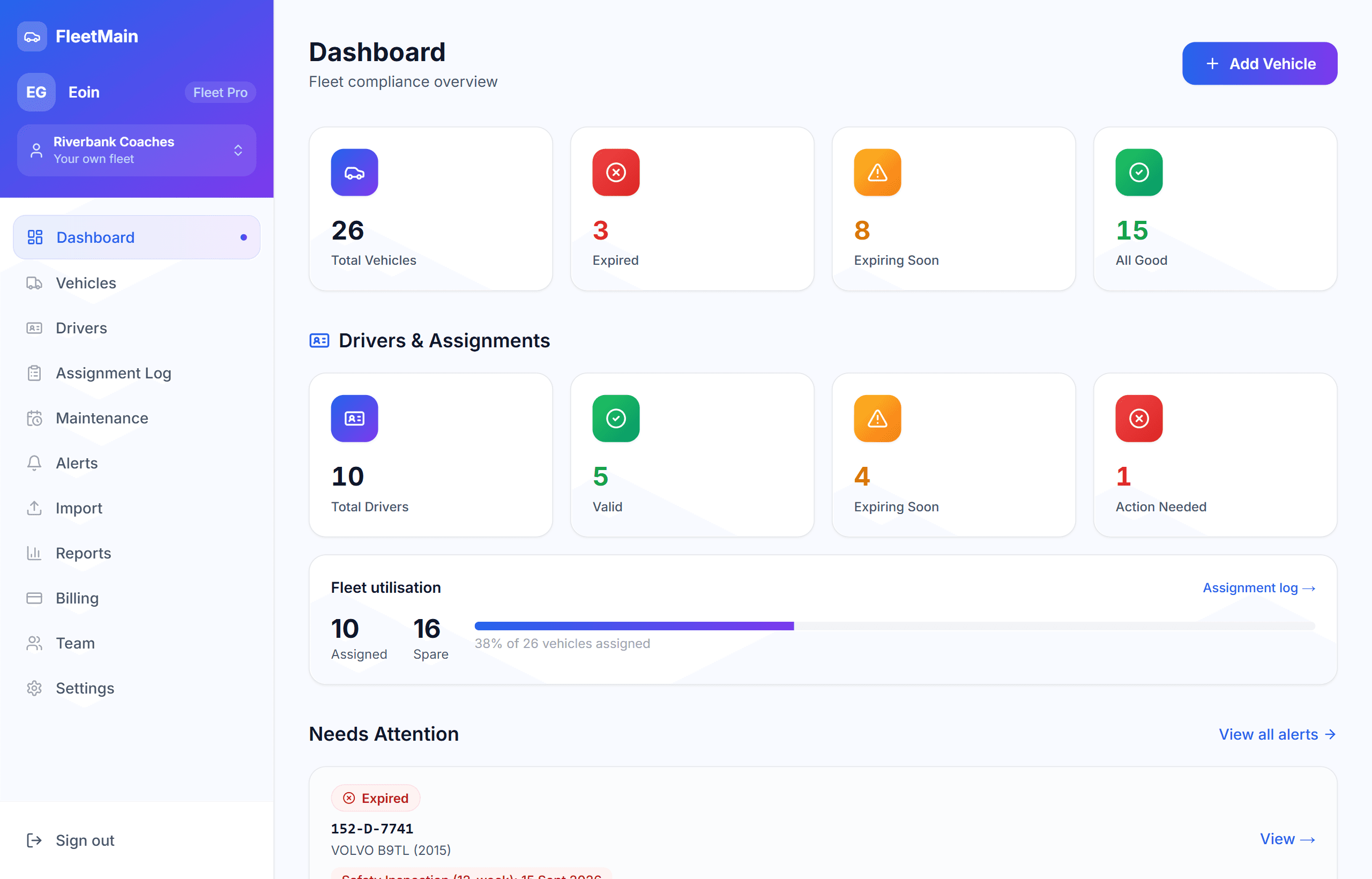
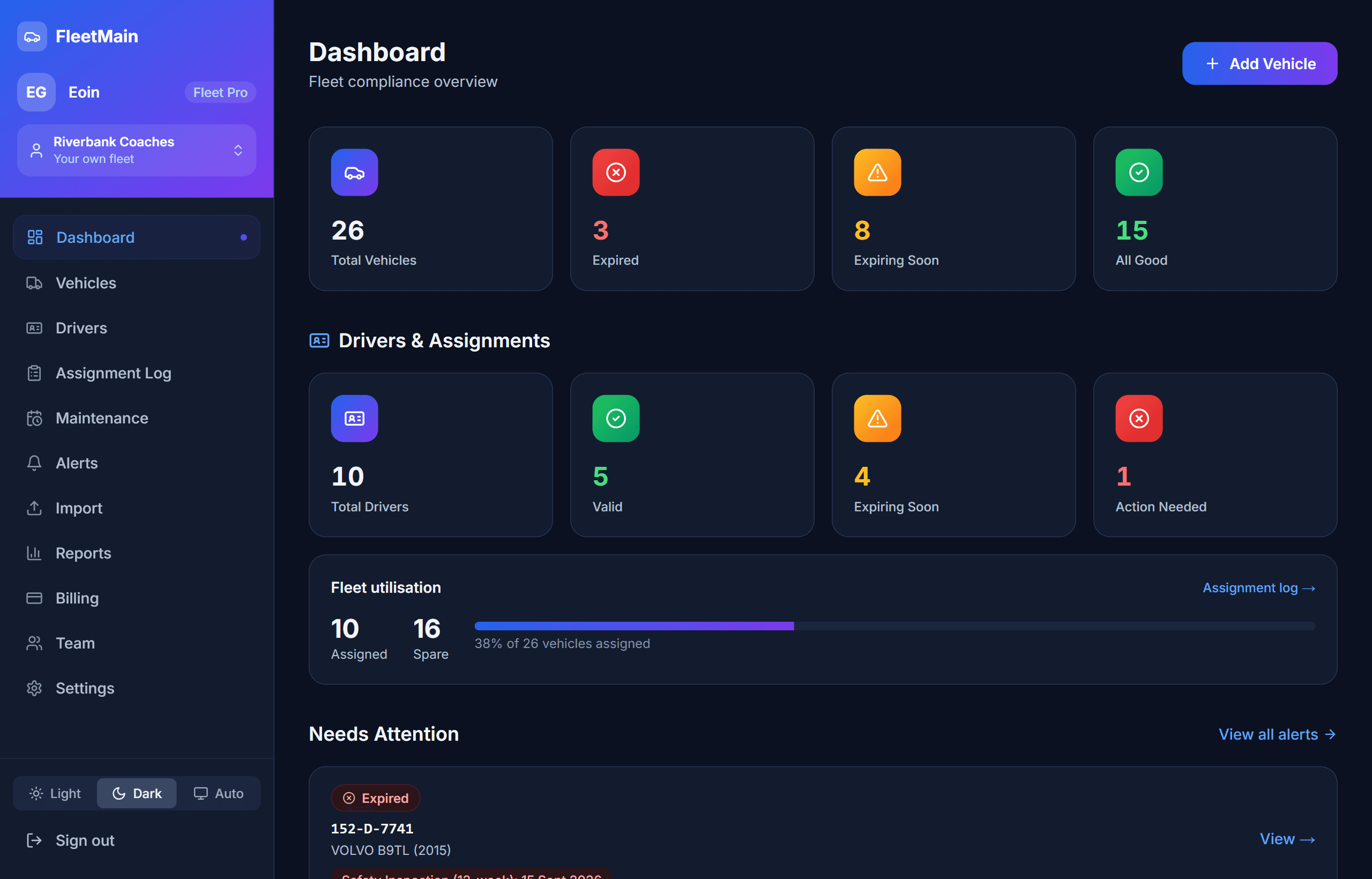
FleetMain was built for exactly this list. For each vehicle it tracks motor tax, the NCT or CVRT (or the MOT for a UK vehicle), insurance, tachograph calibration, safety inspections, the bus vehicle licence, the taxi vehicle licence and service schedules by mileage and time. Fleet-wide dates such as a fleet insurance policy or an operator licence are set once for the whole fleet. On the Business and Fleet Pro plans it also tracks each driver's licence, Driver CPC card, tachograph card and ADR certificate, and keeps the log of who had which vehicle and when.
You choose up to three reminder points for the fleet, anywhere from 1 to 365 days ahead, and anything that lapses keeps coming back in a regular reminder until it is renewed. Regional managers can be named on a group of vehicles so they get the reminders for their own vehicles only. The dashboard colours every date green, amber or red, and if you would rather not load the fleet yourself, the FleetMain team will do it for free.
This article is a general checklist, not legal advice. Each date's rules are set out in the linked guides and the official sources below, and should be confirmed for your own vehicles and drivers.
Common questions
What documents does a company van need in Ireland?
Motor tax, insurance, and a valid CVRT certificate from its first registration anniversary, with the CVRT, tax and insurance discs displayed. A van taxed at the goods rate also needs an RF111A goods declaration on file. Its owner must keep maintenance and defect records for two years, and drivers must do a walkaround check before driving it.
How often does a van need a CVRT?
Every year, starting on the first anniversary of its first registration. Vans don't follow the car's four-year NCT cycle.
What does a truck or bus operator need to track?
For each vehicle: motor tax, insurance, the CVRT, tachograph calibration and periodic safety inspections, plus the bus vehicle licence for buses. For each driver: the driving licence, Driver CPC card, tachograph card and, for dangerous goods, the ADR certificate. For the business: the operator licence and the RSA annual self-declaration.
Who is responsible if a company vehicle is untaxed, uninsured or out of test?
Often both the driver and the business. For driving without insurance, an NCT or a CVRT, the vehicle's owner can be prosecuted as well as the driver, and a company that can't name the driver on a fixed charge notice commits an offence of its own.
How far ahead should I be reminded about each date?
Far enough to do the job. A test needs a few weeks to get a slot, an insurance renewal needs time to compare quotes, and an operator licence renewal needs time to gather financial evidence. Many fleets use a long first reminder for those, and a final one a week before.
Sources
Every rule in this guide was checked against these pages on 20 October 2026.
- motortax.ie
- NCTS: Frequently asked questions (ncts.ie)
- CVRT: What is the CVRT? (cvrt.ie)
- S.I. No. 348 of 2013: vehicle maintenance and repair regulations (irishstatutebook.ie)
- RSA: Tachograph driver card (rsa.ie)
- RSA: Driver CPC periodic training (rsa.ie)
- NDLS: Licence terms (ndls.ie)
- Road Transport Operator Licensing: FAQs (rtol.ie)
- gov.ie: Road passenger transport licensing and testing
- National Transport Authority: Renewing an SPSV licence (nationaltransport.ie)
- Health and Safety Authority: ADR driver training (hsa.ie)
Related guides
- Untaxed, Uninsured or Out of Test: The Penalties in Ireland, and When the Business Is Liable
A lapsed date on a company vehicle is a problem for the business as well as the driver. Here are the fixed charges, penalty points and court penalties for driving without insurance, an NCT, a CVRT or motor tax, and how fixed charge notices work for company vehicles.
- CVRT (the DOE Test): When It's Due, What It Costs and How Retests Work
The CVRT, still the DOE test to most people, comes round every year for every van, truck, bus and heavy trailer. Here is which vehicles need it, when it is due, the 2026 fees, how retests work, and the penalty for driving without one.
- Driver CPC in Ireland: Training, Card Renewal and What Employers Should Check
Every truck and bus driver working in Ireland needs Driver CPC, and a missed year of training only shows up when no new card arrives. Here is how the training and the card work, the fines since December 2025, and what an employer should check.