Untaxed, Uninsured or Out of Test: The Penalties in Ireland, and When the Business Is Liable
Driving without insurance is the most serious lapse in Ireland: up to €5,000, six months in prison and a ban of at least two years. No NCT and no CVRT both bring penalty points, and no motor tax a court fine of up to €2,500. For insurance and test offences, the vehicle's owner can be prosecuted as well as the driver.
At a glance
Checked against 9 official sources- No insurance
- Up to €5,000, up to 6 months, and a ban of at least 2 years for a first offence
- No CVRT
- No fixed charge. On conviction 5 penalty points and up to €5,000
- No NCT
- €60 fixed charge and 3 penalty points
- No motor tax
- Up to €2,500 on conviction. No penalty points
- Owner liable too
- For insurance, the NCT and the CVRT
- Nominating a driver
- Within 28 days of the date of the notice
On this page 11 sections
When a date lapses on a company vehicle, the driver who happens to be behind the wheel isn't the only one exposed. For several of these offences the law makes the vehicle's owner guilty too, and for a company vehicle the owner is the business. Here is what each lapse costs, and what to do when a notice arrives addressed to the company.
The penalties at a glance
No insurance
- Fixed charge
- None
- Penalty points
- 5, if the court doesn't disqualify
- In court
- Up to €5,000, up to 6 months, and a ban of at least 2 years for a first offence
No CVRT certificate
- Fixed charge
- None
- Penalty points
- 5 on conviction
- In court
- Up to €5,000, up to 3 months, or both
No NCT
- Fixed charge
- €60, or €90 in the next 28 days
- Penalty points
- 3
- In court
- 5 points and up to €2,000
No motor tax
- Fixed charge
- None
- Penalty points
- None
- In court
- Up to €2,500
Tax or insurance disc not displayed
- Fixed charge
- €60
- Penalty points
- None
- In court
- A fine on conviction
| Offence | Fixed charge | Penalty points | In court |
|---|---|---|---|
| No insurance | None | 5, if the court doesn't disqualify | Up to €5,000, up to 6 months, and a ban of at least 2 years for a first offence |
| No CVRT certificate | None | 5 on conviction | Up to €5,000, up to 3 months, or both |
| No NCT | €60, or €90 in the next 28 days | 3 | 5 points and up to €2,000 |
| No motor tax | None | None | Up to €2,500 |
| Tax or insurance disc not displayed | €60 | None | A fine on conviction |
Driving without insurance
This is the one that can end a driver's working life for a while. On conviction: a fine of up to €5,000, up to six months in prison, or both. The court must also disqualify the driver from driving for at least two years for a first offence, and at least four years for a second within three years. Only for a first offence, and only if a special reason is proved, can the court decline to disqualify or impose a ban of less than a year. Where there is no ban, 5 penalty points go on the licence instead. Gardaí can also detain the vehicle.
The owner is guilty too. The driver and, if the driver isn't the owner, the owner each commit the offence. The owner's defence is to show the vehicle was used without its consent, and either that it took all reasonable precautions to stop that, or that an employee used it against orders. An employee who drove the vehicle on the owner's express orders has a defence of their own.
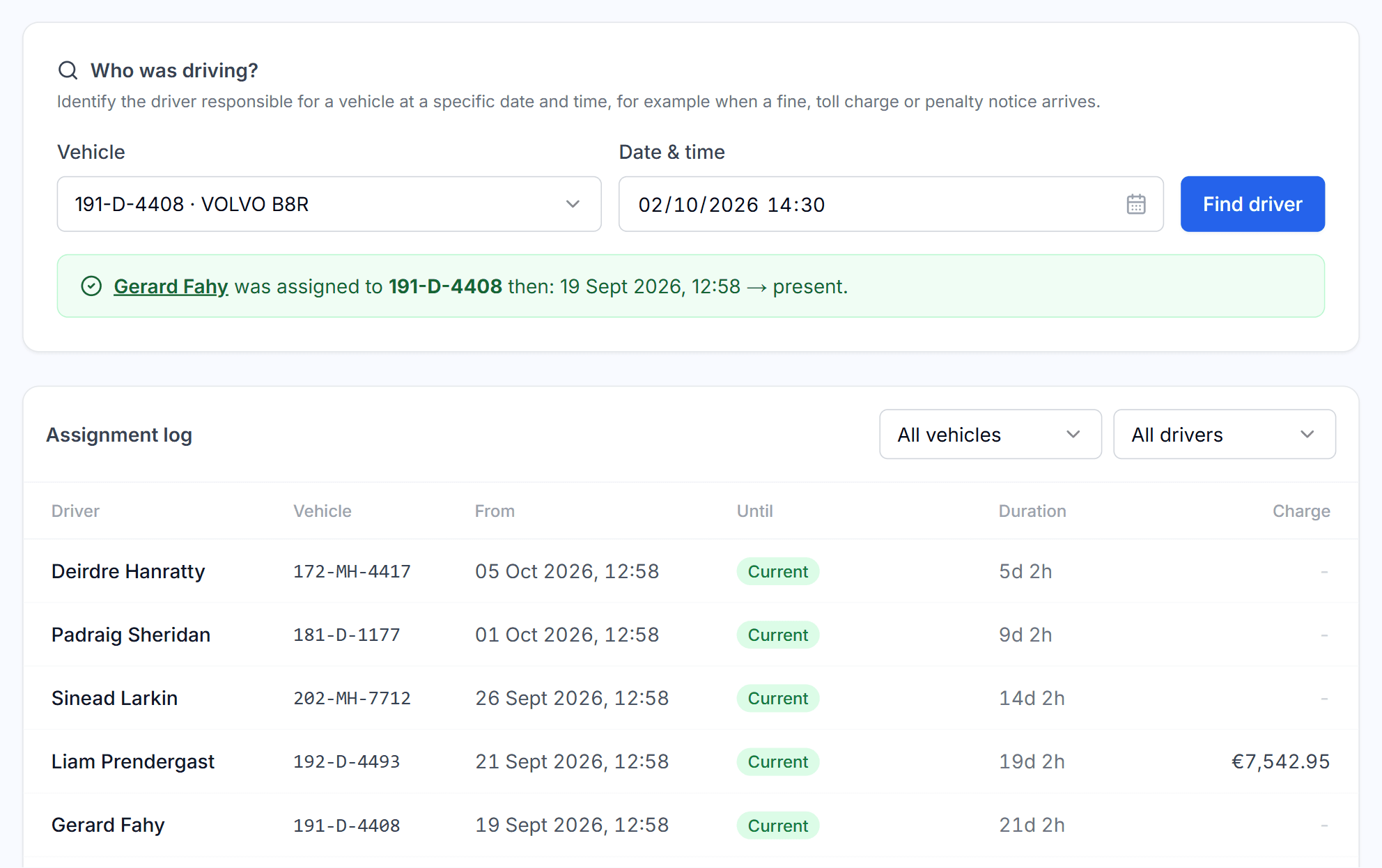
For a business that cuts one way: if a manager sends a driver out in an uninsured van, the driver may have a defence and the company won't. Written rules on who may drive which vehicle, and records showing you checked, are what a defence is built on. See what to agree before you hand over the keys.
Driving without a CVRT
There is no fixed charge. Using a commercial vehicle without a valid Certificate of Roadworthiness goes to court, and on conviction the driver gets 5 penalty points and a fine of up to €5,000, up to three months in prison, or both. The owner can be prosecuted as well. Failing to produce the certificate within 10 days when a Garda asks for it is a separate offence. See the CVRT guide.
Driving without an NCT
A €60 fixed charge and 3 penalty points, rising to €90 if it isn't paid in the first 28 days. If it goes to court, 5 penalty points and a fine of up to €2,000. Here too the owner can be guilty as well as the driver. Driving a vehicle with a dangerous defect, whatever its test status, carries a fine of up to €5,000, up to three months in prison, or both. See the NCT guide.
Driving without motor tax
It isn't a penalty point offence, and there is no fixed charge for it yet. It is dealt with in court, with a fine of up to €2,500 on conviction. Gardaí can detain and remove a vehicle whose tax has been unpaid for two months or more. Not displaying the tax disc is a separate €60 fixed charge with no points. A bill before the Dáil in 2026 would make driving without tax a fixed charge offence and end the paper disc, but until it becomes law the disc still has to be displayed. See motor tax on vans and trucks.
How a fixed charge notice works
- Pay within 28 days of the date of the notice at the standard amount
- Or pay within the next 28 days at the standard amount plus 50%
- After 56 days payment can't be accepted, and a court summons follows
- With the summons comes a final option: pay double the original amount up to 7 days before the court date, and take the points
Penalty points stay on a licence for three years. Twelve points in three years means a six-month ban, and the limit is seven for learner permit holders and in the first two years of a first full licence. Points also have to be declared to insurers and often push premiums up, so a driver's points become part of the fleet's insurance bill.
When the notice is addressed to the company
Camera notices go to the registered owner, so for a company vehicle the notice comes to the business. If someone else was driving, the registered owner completes the Statement of Nomination of Name and Address of Driver of Vehicle on the notice and returns it to the Fixed Charge Processing Office within 28 days of the date of the notice. A nomination sent after 28 days can't be processed, and the notice stays the registered owner's responsibility.
For a penalty point offence, a company can't make it go away by paying: its only option is to nominate the driver. An owner that fails to name the driver commits an offence of its own, with a fine of up to €1,000, unless it can show the information wasn't within its knowledge and it took all reasonable steps to find out. In court, a company vehicle is presumed to have been driven by someone its insurance policy allows to drive it, and if that person can't be identified, the company is deemed to have been driving. That is why a record of who had each vehicle, and when, is worth more than any reminder. See how to prove who was driving.
Staying out of all of it
- Track every date on every vehicle: tax, NCT or CVRT, and insurance, including fleet-wide policies
- Get reminded well before each date, and keep being reminded after one lapses until it is fixed
- Keep a log of which driver had which vehicle, and when, so a notice can be nominated inside the 28 days
- Check drivers' licences and keep a written policy on who may drive what
- Take a vehicle off the road the day a date lapses, not the day someone notices
How FleetMain helps
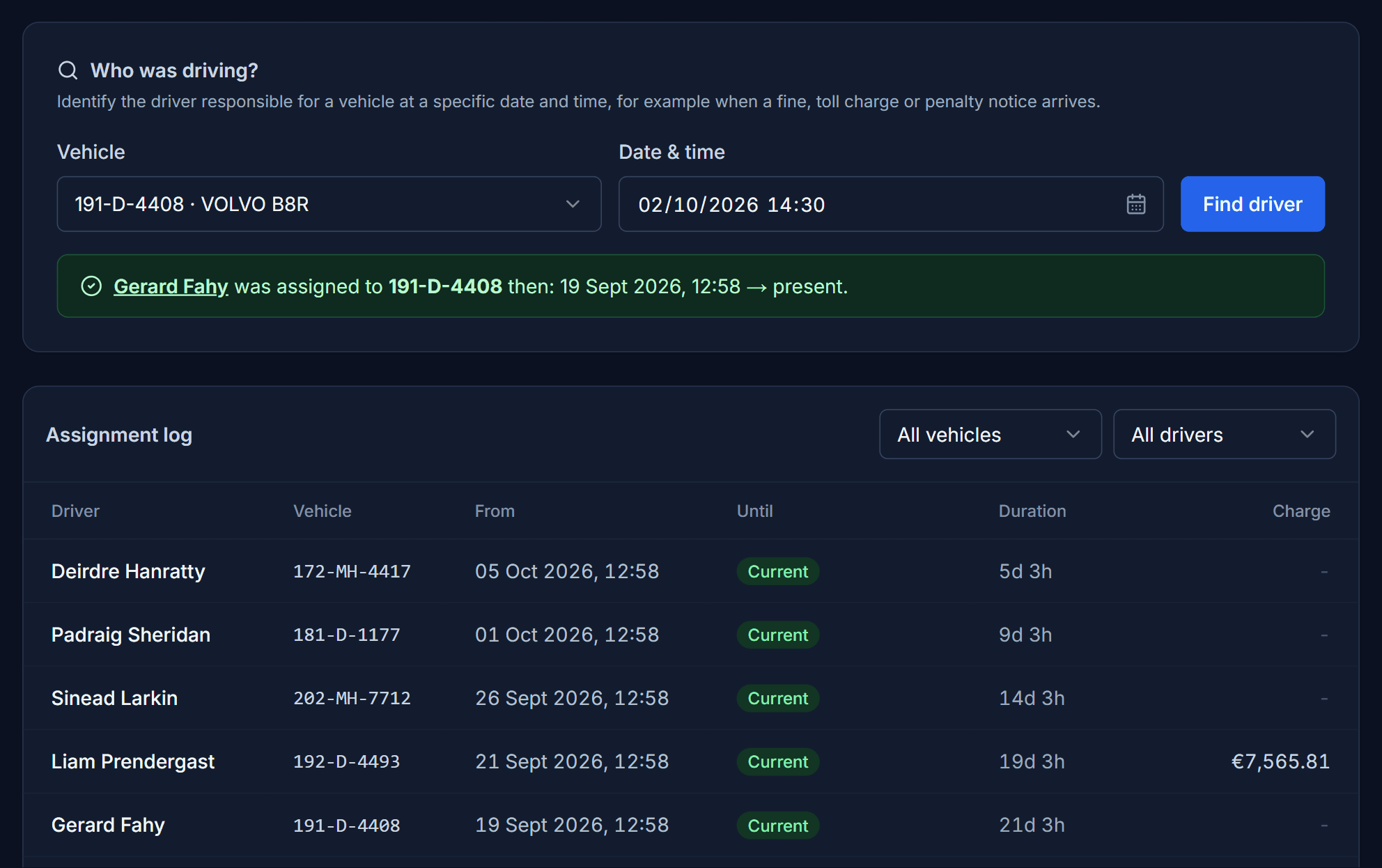
FleetMain tracks motor tax, NCT or CVRT and insurance for every vehicle, including a fleet insurance policy that covers the whole fleet, and emails you before each date: 30, 14 and 7 days ahead by default, or at lead times you choose. Anything that does lapse stays in a regular reminder of expired items, weekly by default, until it is renewed. On the Business and Fleet Pro plans, the driver assignment log records who had which vehicle and when, so the driver on a notice can be found and nominated in seconds.
This article is a general summary of Irish road traffic penalties, not legal advice. If you or your business face a prosecution, take advice from a solicitor.
Common questions
What is the penalty for driving without insurance in Ireland?
A fine of up to €5,000, up to six months in prison, or both. The court must also disqualify the driver for at least two years for a first offence, or four years for a second within three years, unless a special reason is proved for a first offence. Where there is no disqualification, 5 penalty points apply.
Do you get penalty points for no motor tax?
No. Driving without motor tax isn't a penalty point offence. It is dealt with in court, with a fine of up to €2,500, and Gardaí can detain a vehicle that has gone untaxed for two months or more. Not displaying the tax disc is a separate €60 fixed charge.
What is the fine for driving without an NCT?
A €60 fixed charge and 3 penalty points, rising to €90 if it isn't paid within 28 days. If it goes to court, 5 penalty points and a fine of up to €2,000.
Is there a fixed charge for driving without a CVRT?
No. Using a commercial vehicle without a valid Certificate of Roadworthiness leads to a court summons. On conviction the driver gets 5 penalty points and a fine of up to €5,000, up to three months in prison, or both, and the owner can be prosecuted too.
Can a company be prosecuted if an employee drives an uninsured vehicle?
Yes. The driver and, if they aren't the owner, the owner are each guilty of the offence. An employee who drove on the owner's express orders has a defence, while the owner's defence is that the vehicle was used without its consent, either despite reasonable precautions or by an employee going against its orders.
How long does a company have to nominate the driver on a fixed charge notice?
28 days from the date of the notice. Late nominations can't be processed and the notice stays the registered owner's responsibility. For a penalty point offence, a company has to nominate the driver: it can't simply pay.
How long do penalty points last in Ireland?
Three years. Twelve points in three years means a six-month ban, and the limit is seven for learner permit holders and drivers in the first two years of their first full licence.
Sources
Every rule in this guide was checked against these pages on 20 October 2026.
- Road Traffic Act 1961, section 56 (insurance), as revised (revisedacts.lawreform.ie)
- Road Traffic Act 1961, section 26 (disqualification), as revised (revisedacts.lawreform.ie)
- Road Traffic Act 1994, as revised (revisedacts.lawreform.ie)
- Road Traffic Act 2010, as revised (revisedacts.lawreform.ie)
- Road Safety Authority (Commercial Vehicle Roadworthiness) Act 2012 (irishstatutebook.ie)
- S.I. No. 227 of 2024: fixed charge offences (irishstatutebook.ie)
- An Garda Síochána: Fixed charge notices (garda.ie)
- Citizens Information: Penalty points for driving offences (citizensinformation.ie)
- Citizens Information: Driving offences (citizensinformation.ie)
Related guides
- Company Vehicle Fines in Ireland: Who Pays, and How to Prove Who Was Driving
A speeding fine, toll notice or parking charge arrives addressed to the business, not the driver. Here’s what Irish fleet operators are required to do next, and how to identify the responsible driver in seconds instead of days.
- Fleet Compliance Checklist for Ireland: Every Date Your Vehicles, Drivers and Business Need
Tax, tests and insurance are only the start. Here is every compliance date an Irish fleet has to keep, for the vehicles, the drivers and the business itself, with how often each one comes round and where it is renewed.
- Motor Tax on Vans and Trucks in Ireland: Commercial Rates, the RF111A and the Rules
Vans and trucks are taxed on weight, not emissions, and the class you choose decides the bill. Here are the current commercial rates, how the RF111A goods declaration works, the crew cab conditions, and what happens if a goods-taxed van is used privately.