Fleet Service Schedules: By Kilometres, by Months, or Whichever Comes First
Service each vehicle when it reaches the distance or the time limit in its manufacturer's schedule, whichever comes first, counted from the date and odometer reading of its last service. Set a reminder a margin before each limit, keep odometer readings current, and keep every invoice against the vehicle it paid for.
At a glance
- When it is due
- At the distance or the time limit, whichever comes first
- Where the limits come from
- The manufacturer's service schedule for that model and engine
- Hard use
- Many handbooks give shorter intervals for short trips, stop-start work, heavy loads and towing
- Counted from
- The date and odometer reading of the last service
- Records to keep
- Date, odometer reading, work done, cost and the invoice
On this page 11 sections
- Why one limit is not enough
- Where the intervals come from
- Hard use is the schedule most work vehicles are really on
- What to put on a schedule
- Start from the last service
- Get reminded before it is due, not on the day
- The odometer is the weak link
- A service is not a safety inspection
- Keep the invoice with the vehicle
- How FleetMain runs service schedules
- Common questions
A service schedule answers one question for every vehicle in the fleet: when is the next service due? For most vans and cars the answer has two parts, a distance and a date, and the vehicle is due at whichever it reaches first. Fleets that track only one of the two end up servicing some vehicles late and others for no reason.
Why one limit is not enough
Manufacturers set service intervals by distance because parts wear with use, and by time because oil, coolant, brake fluid and rubber age whether the vehicle moves or not. Take a schedule of every 30,000 km or 12 months:
- A van covering 50,000 km a year reaches 30,000 km in about seven months, so the distance decides
- A van covering 10,000 km a year reaches twelve months first, with only 10,000 km on the clock, so the date decides
- A van parked up for the winter is still due when its twelve months are up
Track only the date and the busy van runs months past its service. Track only the distance and the quiet van goes years without one.
Where the intervals come from
From the manufacturer, for that model and engine: the service book, the handbook, or the dealer's records for the vehicle's chassis number. Don't copy a schedule from another vehicle in the fleet. Two vans of the same model can have different engines with different intervals, and what is a timing belt on one engine is a chain on another.
For each vehicle, find out:
- The main service interval, as a distance and a time
- Any item with its own interval, such as a timing belt, brake fluid, coolant, filters or spark plugs
- Whether the manufacturer gives a different schedule for hard use
Hard use is the schedule most work vehicles are really on
Many handbooks give shorter intervals for what they call severe or arduous conditions. The definitions vary by manufacturer, but they usually include:
- Lots of short journeys, where the engine rarely warms up fully
- Stop-start urban work, such as multi-drop deliveries
- Carrying heavy loads or towing
- Long periods of idling
- Dusty sites or unmade roads
That is an ordinary day for a lot of commercial vehicles. Read the definition in the handbook and be honest about which schedule each vehicle is on. A delivery van serviced on the standard interval is often a delivery van overdue for a service.
What to put on a schedule
Main service
- Usually set by
- Distance and time
- Notes
- From the manufacturer's schedule for that engine
Timing belt
- Usually set by
- Distance and years
- Notes
- Check the handbook: some engines have a chain instead
Brake fluid
- Usually set by
- Time
- Notes
- It absorbs moisture as it ages, whatever the mileage
Tyres
- Usually set by
- Condition
- Notes
- Check tread depth, damage and age between services
| Schedule | Usually set by | Notes |
|---|---|---|
| Main service | Distance and time | From the manufacturer's schedule for that engine |
| Timing belt | Distance and years | Check the handbook: some engines have a chain instead |
| Brake fluid | Time | It absorbs moisture as it ages, whatever the mileage |
| Tyres | Condition | Check tread depth, damage and age between services |
Keep the list short. A schedule nobody acts on is worse than none, because it looks like the job is covered.
Start from the last service
A schedule needs a starting point: the date and the odometer reading of the last service. Without both, the next due date is a guess. Take them from the last invoice or the service book. If a vehicle's history has been lost, book a service now and start the schedule from that, rather than inventing a date.
Get reminded before it is due, not on the day
A reminder on the due date leaves no time to get the vehicle into a garage. Build a margin into each limit:
- By date, a few weeks ahead, long enough to get a slot
- By distance, a margin before the limit. For a van doing 1,000 km a week, a 2,000 km margin gives about two weeks' notice
Set the distance margin from how far the vehicle actually travels. A margin that gives a quiet car three months' warning gives a busy van three days.
The odometer is the weak link
A distance-based schedule is only as good as the latest odometer reading. If the readings are months old, a busy van can pass its service without anything noticing. Ask drivers for a reading on a fixed day, weekly for high-mileage vehicles and monthly for the rest, and record one whenever a vehicle is at a garage or a test centre.
A service is not a safety inspection
For HGVs, buses and coaches, the service schedule runs alongside the periodic safety inspections operators carry out at set intervals, not instead of them. A service keeps the vehicle mechanically healthy. A safety inspection checks the roadworthiness items, such as brakes, steering, suspension, tyres and lights, and has its own records. See what HGV and bus operators must record. Neither one replaces the annual CVRT.
Keep the invoice with the vehicle
For each service, record the date, the odometer reading, the work done, the cost and the garage, and keep the invoice. That record:
- Shows the vehicle was serviced on time if a warranty claim comes up
- Adds value when you sell, because buyers pay more for a documented history
- Shows which vehicles cost the most to keep on the road, which is the starting point for working out what each van really costs to run
How FleetMain runs service schedules
Service schedules are on every FleetMain plan, the free one included:
- Set a schedule on a vehicle by distance, by months, or both, and FleetMain works out which limit comes first. Distances follow the vehicle's country: kilometres for Irish vehicles, miles for UK ones
- Start it from the date and odometer reading of the last service
- Add one schedule to several vehicles at once. Each starts from its own latest service record with a reading
- See every schedule's status: OK, due soon (within 30 days, or within the reminder distance, which starts at 10% of the interval) or overdue
- Get an email when a schedule becomes due soon and another if it goes overdue. An overdue service then stays in your regular reminder of lapsed items until the work is marked as done
- Press Mark as done to save the work to the vehicle's service history and restart the schedule from that date and reading
- Attach the invoice, as a PDF or a photo, to the service record
- Get a reminder to update odometer readings weekly, monthly or every two months, so distance-based schedules stay accurate
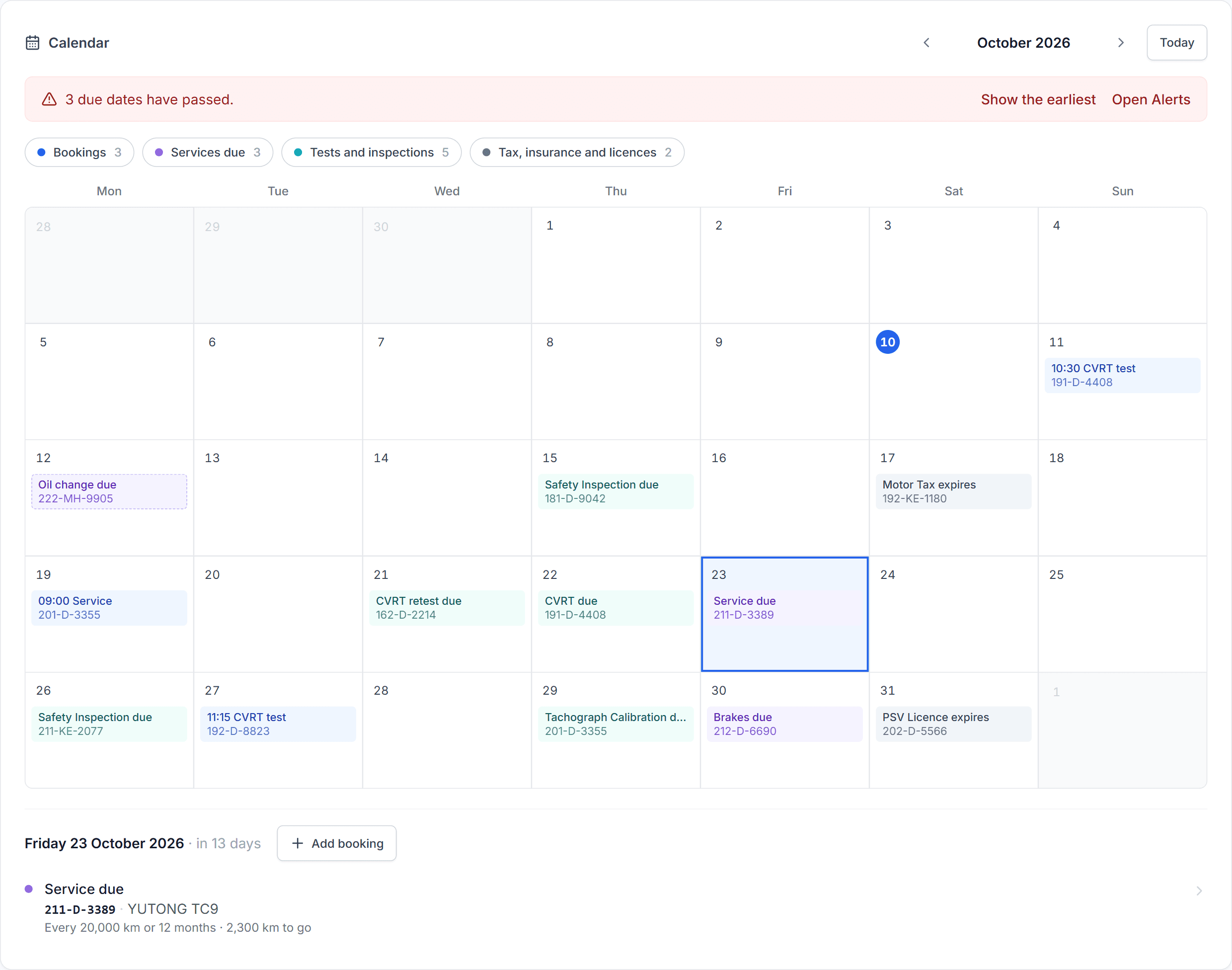
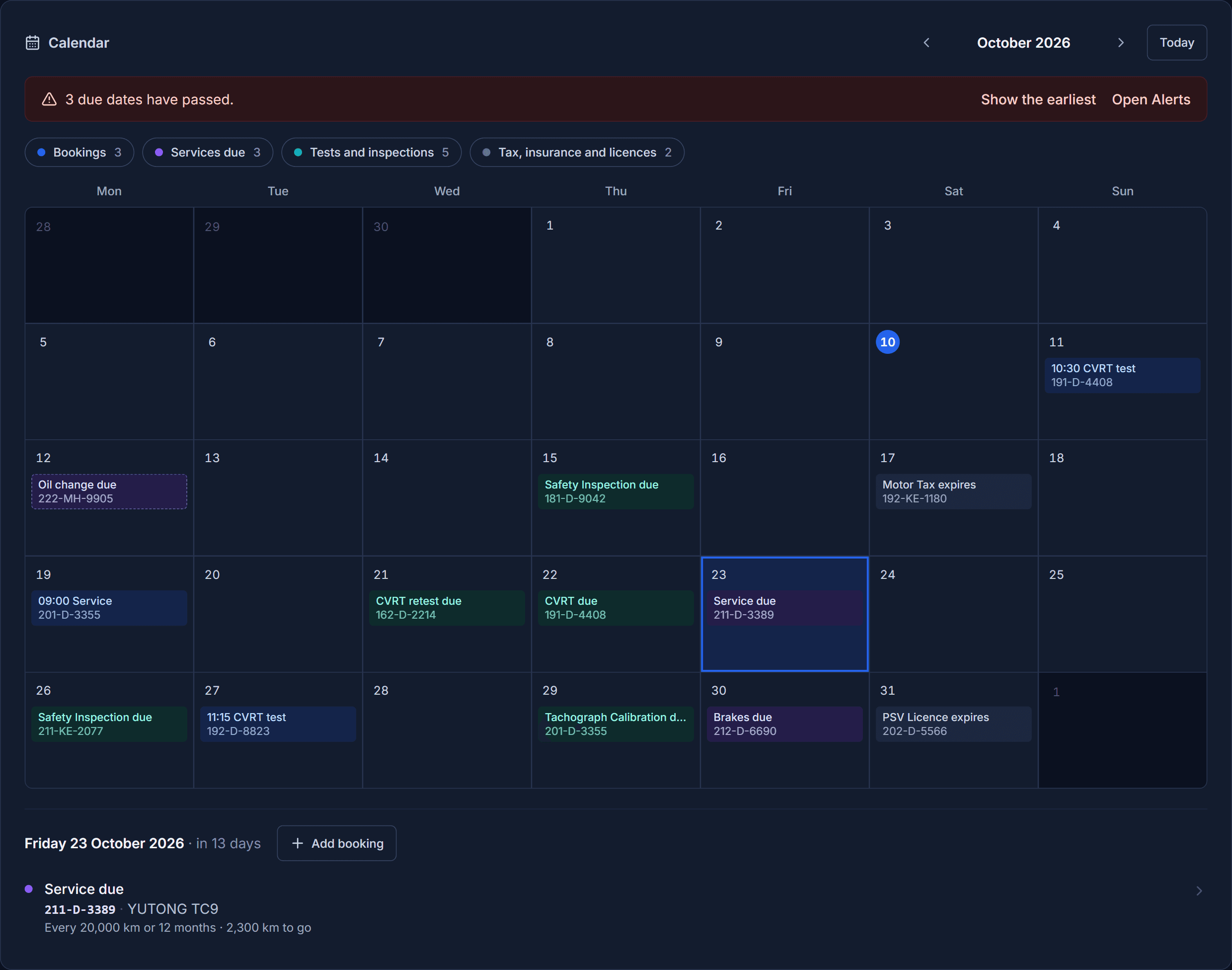
The maintenance calendar shows every service that is due on the day it falls, alongside test dates, tax and insurance. A service that is due by distance goes on the date the odometer is heading for, worked out from the vehicle's recent readings.
Common questions
How often should a company van be serviced?
As often as its manufacturer's schedule says for that model and engine, which is usually a distance and a time limit, whichever comes first. If the van does a lot of short trips, stop-start deliveries, heavy loads or towing, check whether the handbook gives a shorter interval for that kind of use.
What does "whichever comes first" mean on a service schedule?
The vehicle is due at the first of the two limits it reaches. On a schedule of 30,000 km or 12 months, a van covering 50,000 km a year is due after about seven months, and a van covering 10,000 km a year is due at twelve months with only 10,000 km done.
Does a vehicle that hardly moves still need servicing?
Yes. Oil, coolant, brake fluid and rubber parts age with time as well as use, which is why most schedules have a time limit. A vehicle that sat in the yard all winter is still due when its months are up.
Is a service the same as a safety inspection or a CVRT?
No. A service follows the manufacturer's schedule to keep the vehicle mechanically healthy. HGV and bus operators also carry out periodic safety inspections of the roadworthiness items, and every commercial vehicle has its annual CVRT. Each one is tracked separately.
Related guides
- Preventative Maintenance Inspections: What HGV and Bus Operators Must Record
The CVRT is once a year. Your roadworthiness obligation is every single day. Here’s how the periodic safety inspection regime works, what records you’re expected to hold, and how operators keep it manageable.
- What It Actually Costs to Run a Van in Ireland
Most operators price a van on its purchase price and its fuel. The costs that decide whether the job was profitable are the ones nobody writes down. Here is how to build a cost per kilometre you can quote from.
- Fleet Compliance Checklist for Ireland: Every Date Your Vehicles, Drivers and Business Need
Tax, tests and insurance are only the start. Here is every compliance date an Irish fleet has to keep, for the vehicles, the drivers and the business itself, with how often each one comes round and where it is renewed.