Driver CPC in Ireland: Training, Card Renewal and What Employers Should Check
Anyone who drives a truck or bus for work in Ireland needs Driver CPC unless an exemption applies. It is kept by doing one 7-hour module a year at an RSA-approved centre, 35 hours every five years, after which the RSA posts the new card. Driving without it can cost the driver up to €2,500 and the employer up to €5,000.
At a glance
Checked against 8 official sources- Who needs it
- Professional drivers in licence categories C1, C1E, C, CE, D1, D1E, D and DE
- Training
- One 7-hour module a year at an RSA-approved centre: 35 hours every 5 years
- The card
- Issued by the RSA, valid for up to 5 years, carried whenever you drive for work
- Renewal
- Automatic once the training is recorded. The RSA posts the new card before the old one expires
- Waiting for a card
- You can't drive professionally until it arrives
- Fines
- Up to €2,500 for the driver, up to €5,000 for an employer who causes or permits it
On this page 12 sections
- Who needs Driver CPC
- The exemptions
- How periodic training works in Ireland
- What happens if a driver misses a year
- The Driver CPC card
- The fines
- What an employer should check
- Driver CPC is not the transport manager CPC
- The other dates on a professional driver
- Keeping track of it in FleetMain
- Common questions
- Sources
If one of your drivers holds a truck or bus licence and drives for work, their Driver CPC is as much a part of their right to drive as the licence itself. Miss a year's training and nothing happens straight away, which is the problem: the gap only shows when the card comes up for renewal and no new one arrives.
Who needs Driver CPC
Driver CPC, the Certificate of Professional Competence, applies to anyone driving a vehicle in licence categories C1, C1E, C, CE, D1, D1E, D or DE in a public place, unless an exemption covers the journey. In practice that means trucks over 3,500 kg, minibuses, buses and coaches, driven as part of a job.
New drivers qualify by passing the initial CPC tests. Everyone already qualified keeps their CPC through periodic training.
The exemptions
The exemptions are set out in S.I. No. 359 of 2008, as amended. The ones fleets ask about most:
- Vehicles with a maximum speed of 45 km/h or less
- Vehicles used by the Garda Síochána, the Defence Forces, fire services, Civil Defence, the Prison Service and emergency ambulance services, while used for those services
- Vehicles being road tested, and new or rebuilt vehicles not yet in service
- Emergencies and rescue missions
- Driving lessons and driving tests, with no goods or passengers carried for business
- Carrying passengers or goods for personal, non-commercial use
- Carrying material, equipment or machinery the driver uses in their own work, where driving is not the driver's main activity
- Some farming, horticulture, forestry and fishing work carrying the business's own goods within 25 km of base, where driving is not the main activity
The equipment exemption is the one trades rely on, and it is narrower than it sounds. It covers someone bringing their own equipment to the job they are there to do, not a driver whose job is the driving. If you aren't sure, assume CPC applies until the RSA tells you otherwise.
How periodic training works in Ireland
The regulations require at least 35 hours of periodic training every five years, taken in 7-hour blocks each year. The RSA delivers that as one module a year: a one-day classroom course of at least seven hours at an RSA-approved training centre, on a different module each year. Repeating a module already done in the same five-year cycle doesn't count.
Drivers who hold both the truck and the bus CPC need 42 hours, six modules, over the five years.
EU rules now let countries allow up to 12 hours of the training as e-learning, but the RSA's modules remain classroom courses at approved centres.
What happens if a driver misses a year
Nothing visible at first. The RSA's own warning is plain: if the training isn't completed every year, the driver won't receive a new Driver CPC card at the end of the five years. Without a valid card they can't drive professionally.
A driver whose CPC has lapsed doesn't sit the tests again. They complete 35 hours of periodic training (42 for both truck and bus) and then apply to the RSA for a new card. If a driver has fallen behind, ask the RSA how the missing modules can be made up while the current card is still valid, not after it has expired.
The Driver CPC card
The card, formally the driver qualification card, is issued by the RSA, not by the NDLS that issues driving licences. It is valid for up to five years, and the driver must carry it whenever they drive professionally. A Garda or a transport officer can ask to see it at any time.
Renewal is automatic. Once each year's training is recorded on the driver's MyCPC account, the RSA posts the new card before the current one expires. A replacement for a lost, stolen or damaged card costs €50. A driver whose new card hasn't arrived can't drive professionally until it does, which is the best reason to finish the last module well before the expiry date.
The fines
The penalties were updated in December 2025 by S.I. No. 594 of 2025:
| Offence | Who | Maximum fine |
|---|---|---|
| Driving without a valid Driver CPC | The driver | €2,500 (class C) |
| Causing or permitting someone to drive without one | The employer or operator | €5,000 (class A) |
| Not carrying the card, or not producing it when asked | The driver | €1,000 (class D) |
The employer's maximum is double the driver's. Letting an unqualified driver out is treated as the more serious failure, because the employer is the one in a position to check.
What an employer should check
There is no official online service that lets an employer look up a driver's CPC, licence or penalty points. Checks are done with the driver:
- See the Driver CPC card and the driving licence when the driver starts, and record both expiry dates
- Ask the driver to show you their MyCPC training record, which lists the modules done in the current cycle
- Ask for an NDLS Driver Statement if you need the licence details and penalty points. It is free, but it is sent to the driver, not to you
- Diarise each card's expiry date and the month each driver's module is due
- Spread training through the year. If every driver leaves their module until December, the fleet loses its drivers in the busiest weeks
- Check agency drivers the same way. The fine for causing or permitting falls on whoever let them drive
Driver CPC is not the transport manager CPC
The two get confused. Driver CPC is the driver's qualification. The transport manager CPC is a separate, higher qualification that a licensed haulage or passenger operator needs for the person who manages its transport. A fleet full of CPC-qualified drivers still needs a qualified transport manager to hold an operator licence.
The other dates on a professional driver
- Driving licence: a truck or bus licence (categories C and D) is usually issued for five years, and every renewal needs a medical report
- Digital tachograph driver card: valid for five years. EU rules say to apply at least 15 working days before it expires. The RSA issues the new card no earlier than 28 days before the old one's expiry date and suggests applying three to four weeks ahead
- ADR certificate, for carrying dangerous goods: valid for five years, with a refresher course in the final year
Each runs on its own cycle, so a driver can be fully trained and still off the road because one card lapsed. See the four driver dates that matter.
Keeping track of it in FleetMain
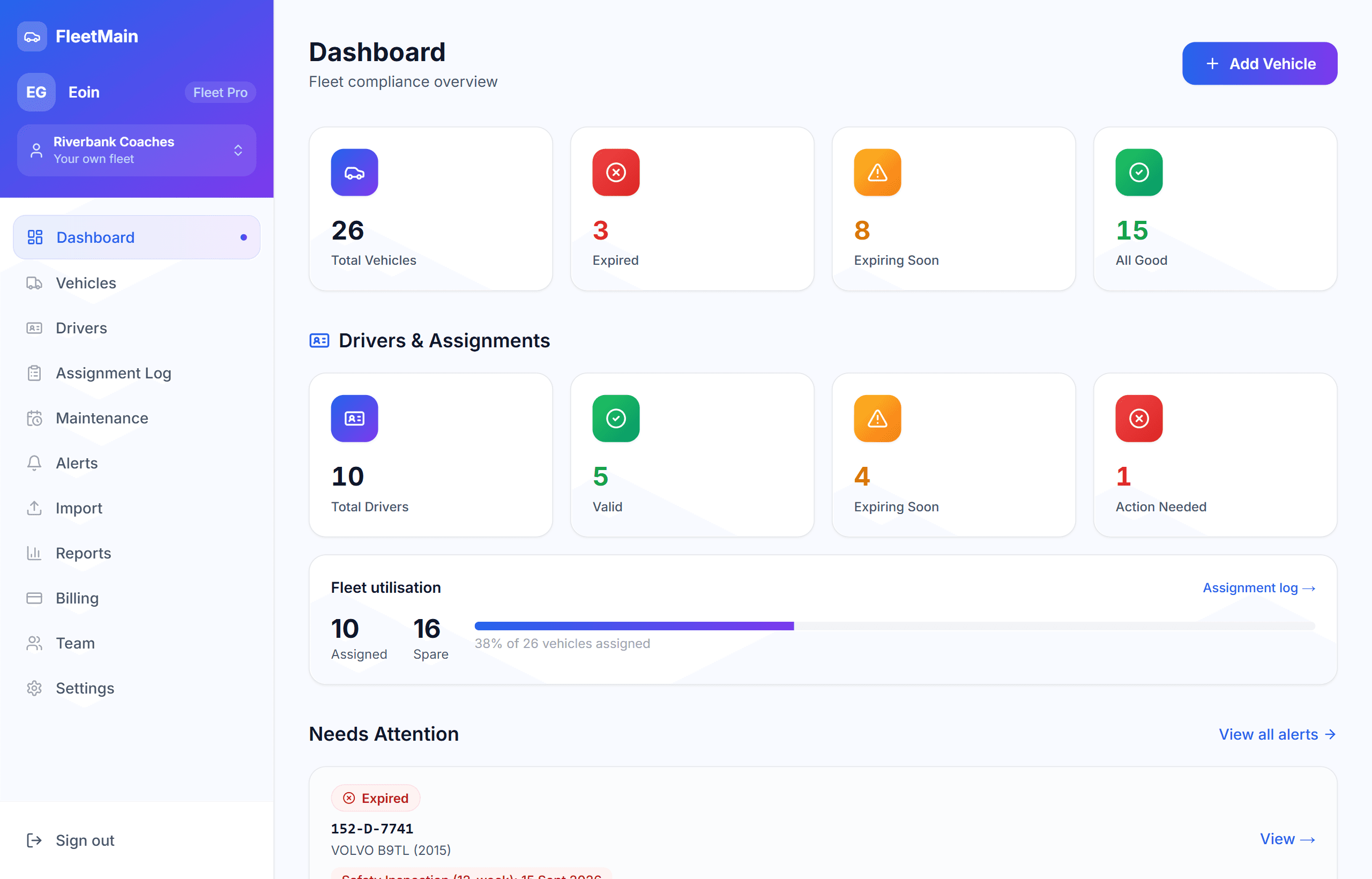
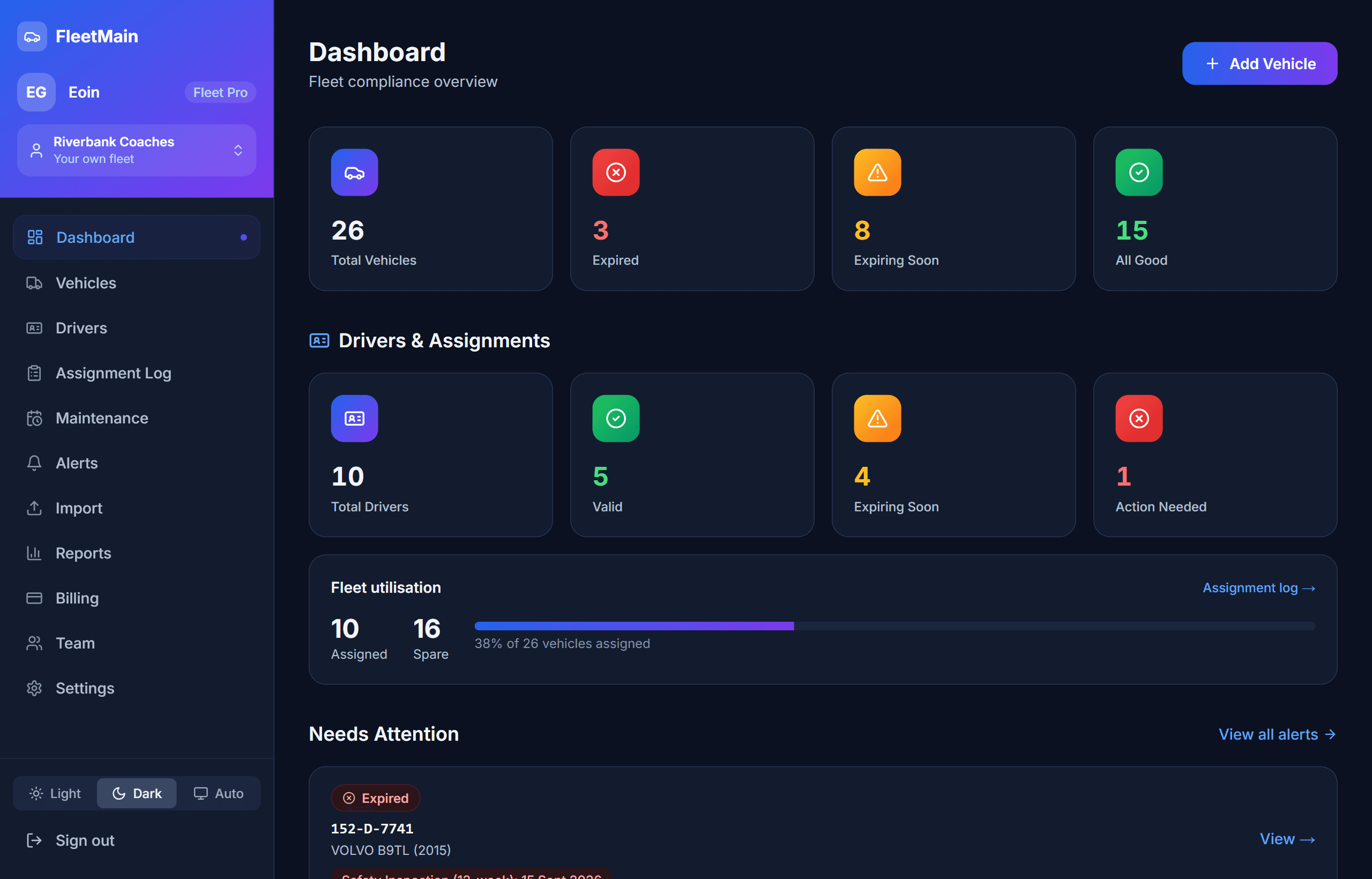
On the Business and Fleet Pro plans, each driver in FleetMain carries their driving licence, Driver CPC card, tachograph card and ADR certificate expiry dates. You get an email before each one is due, on the reminder schedule you set for the fleet, and a warning if you assign a vehicle to a driver whose documents have lapsed. When a driver leaves, archive them rather than deleting them, and their history stays on file.
FleetMain tracks the card's expiry date. It doesn't record which modules a driver has done: that record lives in the driver's MyCPC account.
This article is a general summary of the Driver CPC rules, not legal advice. Confirm exemptions and your own drivers' training position with the Road Safety Authority.
Common questions
How many hours of Driver CPC training do I need in Ireland?
35 hours every five years, taken as one 7-hour module a year at an RSA-approved centre. A driver who holds both the truck and the bus CPC needs 42 hours, six modules, over the five years.
Can Driver CPC training be done online in Ireland?
EU rules now let countries allow up to 12 hours of the training as e-learning, but the RSA's periodic training modules are classroom courses at approved centres. Check with the RSA before booking anything sold as online CPC.
What happens if my Driver CPC card expires?
You can't drive professionally until you have a valid card again. To get one, complete 35 hours of periodic training (42 if you hold both truck and bus CPC) and apply to the RSA. There are no tests to sit again.
Who issues the Driver CPC card in Ireland?
The Road Safety Authority. The NDLS issues driving licences, but the CPC card comes from the RSA, which posts the new one before the current card expires once your training is recorded.
Can an employer check a driver's CPC online?
Not directly: there is no official look-up for employers. See the card and its expiry date, ask the driver to show you their MyCPC training record, and ask for their NDLS Driver Statement if you need their licence details and penalty points.
Do I need Driver CPC to drive a van?
Not for a van you drive on a category B licence. Driver CPC applies to vehicles in categories C1, C, D1, D and their trailer versions, such as trucks over 3,500 kg, minibuses and buses.
Sources
Every rule in this guide was checked against these pages on 20 October 2026.
- RSA: What is Driver CPC? (rsa.ie)
- RSA: Periodic training and compliance (rsa.ie)
- RSA: Driver CPC card (rsa.ie)
- S.I. No. 359 of 2008: European Communities (Vehicle Drivers Certificate of Professional Competence) Regulations (irishstatutebook.ie)
- S.I. No. 594 of 2025: European Union (Vehicle Drivers Certificate of Professional Competence) Regulations 2025 (irishstatutebook.ie)
- NDLS: Licence terms (ndls.ie)
- NDLS: Order my driver statement (ndls.ie)
- RSA: Tachograph driver card (rsa.ie)
Related guides
- Driver Compliance for Fleets: Licences, CPC, Tachograph Cards & ADR
Vehicle compliance is only half the job. Here’s how to keep your drivers legal too, covering driving licences, Driver CPC, digital tachograph cards and ADR, and how to prove who was driving when a fine arrives.
- Drivers’ Hours and Tachograph Rules: The Limits Irish Operators Work To
Driving time limits, break requirements and tachograph downloads are where roadside enforcement bites hardest. Here’s a plain summary of the limits, the records you have to hold, and the scope change that pulled more vans into the rules.
- Fleet Compliance Checklist for Ireland: Every Date Your Vehicles, Drivers and Business Need
Tax, tests and insurance are only the start. Here is every compliance date an Irish fleet has to keep, for the vehicles, the drivers and the business itself, with how often each one comes round and where it is renewed.